


Some welding jobs are simply too big to do by hand. Large pressure vessels, wind tower sections, and long pipe runs all have seams that stretch for metres. Moving the torch manually across these seams is slow and tiring, and it quickly becomes the bottleneck in production.
A welding manipulator solves this problem. It holds the welding torch and moves it along the seam automatically, at a steady, controlled speed.
As an experienced Welding Manipulator Manufacturer in India, CARMAC Technologies provides automated welding solutions designed for demanding heavy-fabrication applications.
What Is a Welding Manipulator?
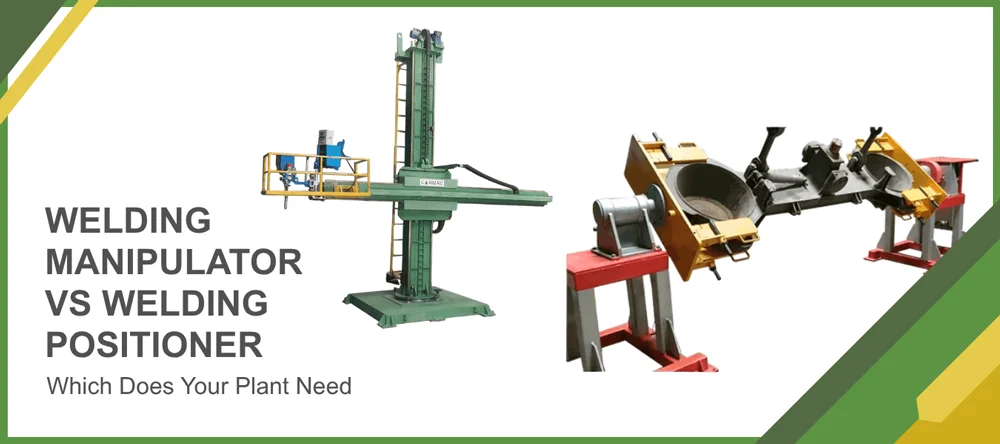
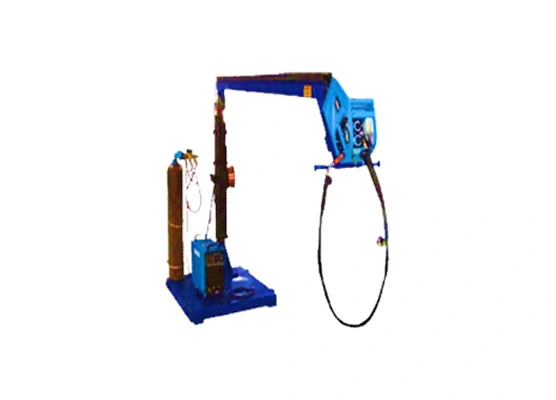
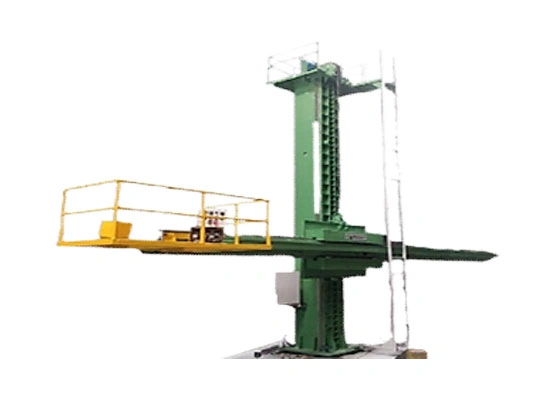
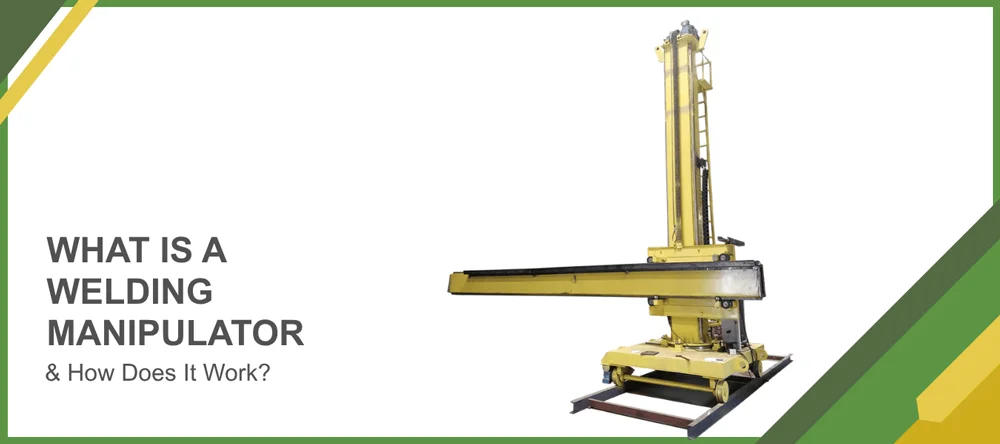
A welding manipulator is an automated welding torch positioning system built around a vertical column and a horizontal boom.
The column travels up and down, and the boom extends and retracts. A torch carriage rides along the boom carrying the welding head. Together, they trace a precise path across the workpiece, so the welder does not have to guide the torch seam by seam.
Manipulators are most common in submerged arc welding (SAW). They also run MIG/MAG, flux-cored, and plasma processes. Typical applications include:
- Longitudinal seams on pipe and tank shells
- Circumferential joints on pressure vessels (paired with turning rolls)
- Plate butt welds in shipbuilding and wind tower manufacturing
Unlike a six-axis robotic arm, a manipulator moves along two to four simpler axes. This makes it less flexible for complex 3D geometry. However, it is far better at holding a steady bead over long, heavy welds, and it is cheaper to buy and maintain.
How Does a Welding Manipulator Work?
A manipulator works by converting manual torch movement into motorized, programmable motion:
- Positioning – the column and boom align the torch over the joint’s start.
- Height and angle setup – the torch holder is adjusted via a cross-slide for stick-out and work angle.
- Arc initiation – the operator sets voltage, wire feed, and travel speed, then starts the arc.
- Controlled travel – the carriage moves at a fixed, adjustable speed, holding consistent arc length and heat input.
- Synchronized rotation – on cylindrical parts, boom travel synchronizes with a welding rotator or turning rolls, keeping the torch at the ideal “flat” position while the part rotates.
- Shutdown – travel and the arc stop, and the boom repositions for the next pass.
Column and Boom Welding Manipulator Working Principle
The Welding Column and Boom working principle comes down to two motion systems working together:
- The column raises and lowers the boom, and in many designs also slews-rotating the whole assembly around its base to reach different parts of a workpiece.
- The boom extends and retracts over the workpiece, carrying the carriage-the torch’s travel mechanism-along its length at a controlled speed.
Both axes run on electric motors (often AC servo or variable-frequency drives) through a pendant or PLC panel.
Welding Manipulator Components and Setup
A standard welding manipulator components and setup package includes:
- Base/column – vertical support, fixed or rail-mounted
- Boom – the arm extending over the workpiece
- Torch carriage – controls travel speed and direction
- Cross-slide and torch holder – fine-tunes height, angle, and position
- Control pendant/PLC panel – sets speed and start/stop sequencing
- Flux/wire feed mounting – holds the hopper and feeder for SAW
- Limit switches and encoders – enforce limits and give positional feedback
Welding Manipulator vs Positioner: Working Mechanism
These two machines are often confused, but they solve opposite problems. The welding manipulator vs positioner working mechanism difference comes down to what actually moves:
- Welding manipulator: Moves the torch. The workpiece stays put or rotates on a separate device.
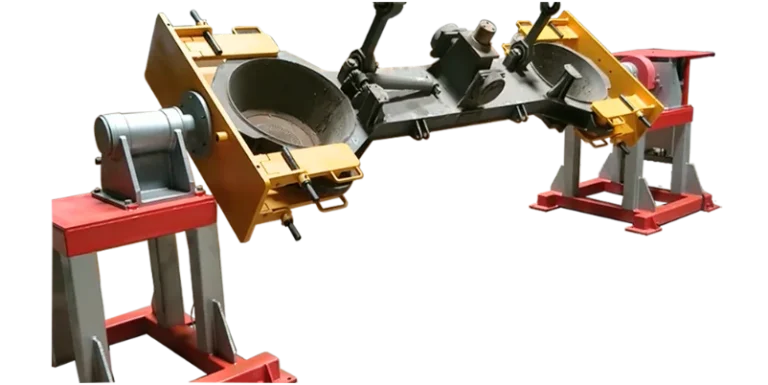
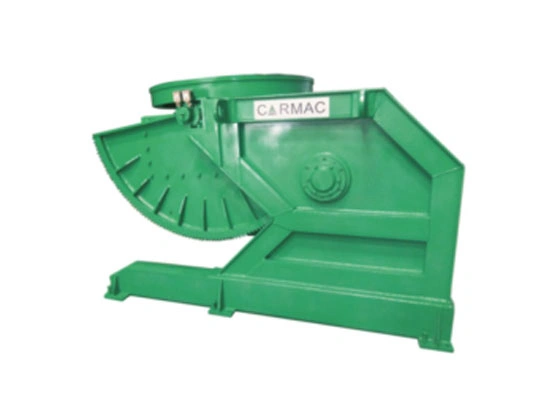
- Welding Positioner: Moves the workpiece, rotating or tilting it so the joint sits flat. The torch stays largely stationary.
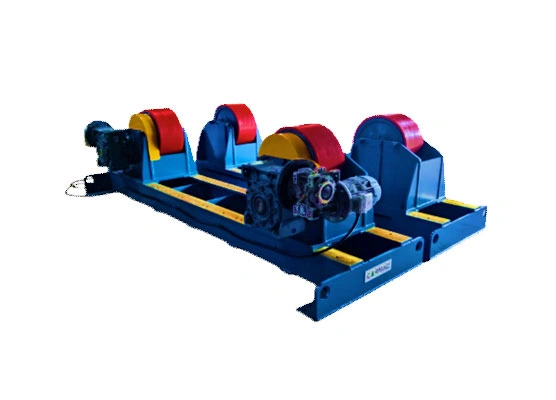
Heavy fabrication shops typically use both together. A Heavy-Duty Positioner or turning rolls rotate the part, while the manipulator’s boom holds the torch steady and controls travel speed along the rotation axis. This setup produces most circumferential vessel and pipe welds.
Submerged Arc Welding Manipulator Integration
Submerged arc welding manipulator integration is one of the most common applications. SAW’s flux-covered arc makes hand-guided travel difficult, and its high deposition rates need precise, steady speed.
The boom carries the SAW head, wire feeder, and flux hopper as one assembly. Carriage speed directly controls heat input and bead shape. Paired with turning rolls such as a Self-Centering Rotator, or with a rail-mounted base, a manipulator turns SAW into a high-throughput process.
Benefits of Welding Manipulators for Manufacturers
The core welding manipulator benefits for manufacturers are consistency and throughput:
- Fewer defects: Motorized, repeatable travel reduces defects and rework.
- Less operator fatigue: Operators shift from physically guiding a torch for hours to monitoring parameters, which cuts fatigue around heavy, hot workpieces.
- Larger parts: Shops can weld parts too large for manual travel.
- Flexibility: A single manipulator, reconfigured with different tooling, often serves several part types and geometries.
Conclusion
A welding manipulator is a motorized column-and-boom system that gives precise, repeatable control over torch travel. Manual welding struggles to match this on long, heavy seams.
Once you understand how the column, boom, and carriage work together, and how a manipulator complements a positioner rather than replacing it, it becomes easier to judge where it fits your process.
For shops running SAW, long structural seams, or large-diameter vessels, a well-specified system from a trusted Welding Manipulator Manufacturer in India like CARMAC Technologies Pvt. Ltd. can help build a more repeatable, higher-throughput welding cell.
Frequently Asked Questions
Welding manipulator benefits include better weld consistency, higher throughput, less operator fatigue, and reduced rework.
Welding manipulator carriage and boom travel provide different movements: the boom positions the torch, while the carriage controls its travel during welding.
An industrial automatic welding manipulator guide should consider boom length, column height, load capacity, and speed range based on your workpiece and welding process.
Yes-submerged arc welding manipulator integration is one of the most common configurations. The boom carries the SAW head, wire feeder, and flux hopper together, and controlled carriage speed is essential for consistent heat input.
No. A manipulator moves the torch across a stationary or separately rotating workpiece, while a Welding Positioner rotates or tilts the workpiece to present the joint optimally. Many shops use both together for circumferential welds.
Welding manipulator load capacity should cover the full boom assembly-torch, wire feeder, and flux hopper for SAW-not just the torch weight alone.
Yes, welding manipulator torch oscillation weaves the torch side-to-side via the cross-slide, useful for wide beads, multi-pass fills, and gap-bridging.
A rail-mounted welding manipulator runs its column along a floor rail, so the machine travels the distance-ideal for long seams or multiple fixed stations.
A welding manipulator vs robotic welding arm comparison favors the manipulator on cost-fewer axes and simpler controls, though robots handle complex geometry better.
Welding manipulator maintenance and calibration usually run on a set schedule-checking motor alignment, lubricating rails, and testing limit switches, often quarterly.
Welding manipulator travel speed range should cover both slow SAW passes and faster MIG runs-a wide, adjustable range fits more job types.
A welding manipulator for small fabrication shops pays off with repetitive long-seam work; occasional short welds may not justify it.
Welding manipulator safety features typically include travel limit switches, emergency stops, encoder feedback, and motor overload protection.