


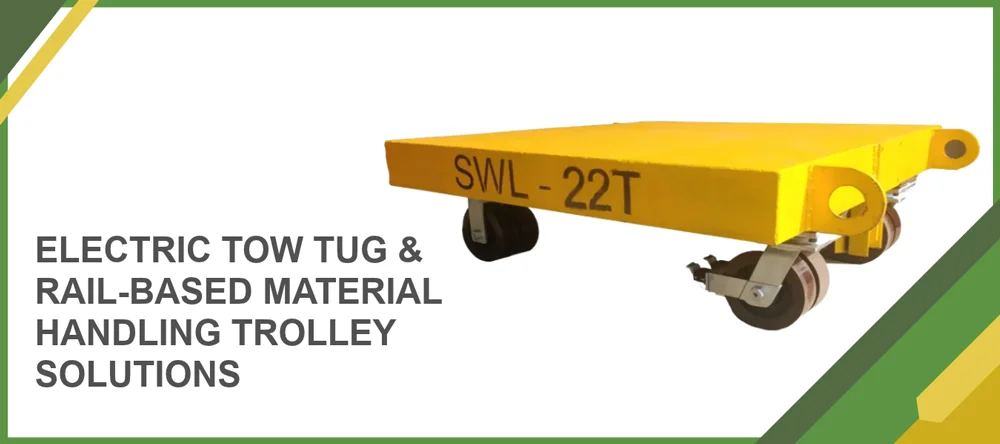
Moving heavy loads across a shop floor is one of the most common challenges in any plant. A battery-operated electric tow tug and a rail-based material handling trolley are two of the most effective ways to solve it.
Without the right equipment, costs add up fast: strained backs, damaged goods, busy forklifts and production delays. Heavy fabrication, rolling stock, wind energy, automotive, pharma and warehousing plants face this every day.
As a material handling equipment manufacturer in India and MasterMover’s Indian partner, CARMAC Technologies Pvt. Ltd. offers both electric tugs and rail-based battery-operated trolleys, built around your load.
In this blog, we explain how each solution works, where each one fits, and how to choose between them.
What Is a Battery-Operated Electric Tow Tug?
An electric tug is a battery-powered, pedestrian-operated machine that lets one person push, pull and steer heavy wheeled loads: trolleys, roll cages, dollies, moulds, tanks, reels and more. The operator walks with the machine and controls it with simple handle controls. No forklift licence is required, and there are zero emissions at the point of use.
MasterMover, the UK-based manufacturer of electric tugs, designs these machines for loads from a few hundred kilograms up to very heavy industrial loads. MasterMover’s range covers:
- Compact range: up to 3,000 kg
- Performance range: up to 70,000 kg
- Ultra range: up to 300,000 kg
As MasterMover’s Indian partner, CARMAC offers the following tug models:
|
Series |
Models |
Best for |
|
SmartMover |
SM 100+, SM 200+ |
Compact tug pushers for trolleys in tight spaces (up to 2,000 kg) |
|
MasterTug |
MT 300+ to MT 2000+ |
Pedestrian tugs to push, pull and steer wheeled loads (up to 20,000 kg) |
|
MasterTow |
TOW 200 |
Easy-to-use tow tug for trolleys and trains of loads |
|
AllTerrain |
ATT 400+, ATP 400 |
Rugged machines for indoors, outdoors, slopes, castors and rails |
|
PowerSteered |
PS 800+, PS 3000+ |
Remote-controlled tugs for very heavy loads with better operator visibility |
For the heaviest jobs, MasterMover’s patented MultiLink technology lets one remote operator control several tugs attached to a single load, moving together in synchronised motion.
What Is a Rail-Based Material Handling Trolley?
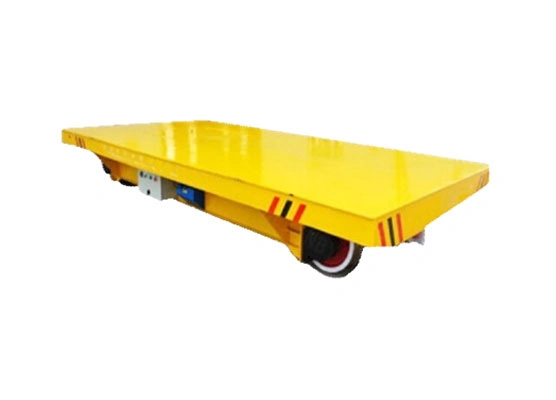
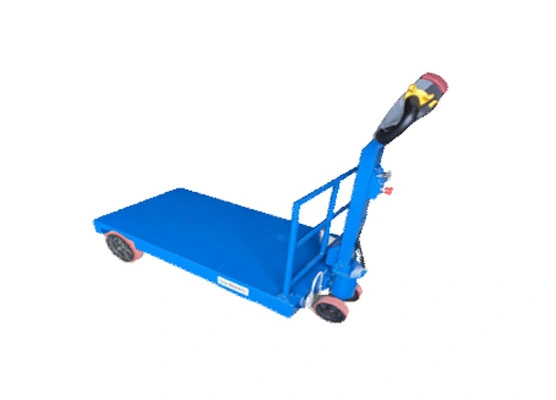
A rail-based trolley (also called a transfer trolley or transfer cart) is a heavy-duty platform that runs on rails fixed in the floor. It carries heavy, bulky loads along a fixed path, for example from one bay to another, from fabrication to painting, or from a production line to dispatch.
CARMAC Technologies Pvt. Ltd. designs and manufactures customised trolleys in several formats:
Rail-based, battery-operated trolleys: capacity 1T to 50T (electric-operated option up to 30T). Features include speed control, automatic braking and steering assistance, in both rail-mounted and floor-mounted versions.
- Rail-based manual trolleys: capacity 2T to 50T, with smooth movement along the rail and a platform or deck sized to the load.
- Castor-based manual trolleys: capacity 2T to 50T, for flexible movement where laying rails is not practical.
Because each trolley is built around your load, deck size, height and handling needs can be customised.
Electric Tow Tug vs Rail-Based Trolley at a Glance
|
Battery-Operated Electric Tow Tug |
Rail-Based Material Handling Trolley |
|
|
How it works |
Pedestrian-operated; one person pushes, pulls and steers wheeled loads |
Heavy-duty platform running on rails fixed in the floor |
|
Route |
Variable routes (with castor-based trolleys) |
Fixed, repeated routes |
|
Capacity |
MasterMover range up to 300,000 kg; AllTerrain up to 80,000 kg on rails |
CARMAC trolleys from 1T to 50T |
|
Power |
Battery; lithium, interchangeable batteries and onboard chargers on selected models |
Battery-operated or manual versions |
|
Operator |
No operator licence required for pedestrian tugs |
Speed control, automatic braking and steering assistance on battery-operated versions |
|
Best for |
Moving many trolleys across the plant with one machine |
Very heavy loads needing a stable, guided path |
Why Use Battery-Operated Electric Tow Tug and a Rail-Based Material Handling Trolley Together?
Many plants get the best results by combining both solutions:
- A rail-based trolley gives a fixed, stable, repeatable path for very heavy loads.
- An electric tug, such as the AllTerrain range, can push the load on rails or tow castor-based trolleys. MasterMover states that the AllTerrain range can move up to 5,000 kg on castors and up to 80,000 kg on rails, depending on the application.
This means you do not always need a dedicated drive on every trolley. One tug can serve many trolleys across the plant, which is useful when you have multiple loads to move but need to keep the investment manageable.
Key Benefits of Electric Tow Tugs and Rail-Based Trolleys
- Safer handling. Operators stop pushing and pulling heavy loads by hand, which reduces manual handling injuries and fatigue.
- No operator licence required for pedestrian electric tugs.
- Zero emissions. Battery power is suitable for indoor workshops, clean areas and enclosed spaces.
- Controlled movement. Speed control, automatic braking and emergency stop features keep movement predictable. AllTerrain tugs, for example, offer a two-speed selector and can be set up with custom speeds.
- Frees up forklifts and cranes. Routine transfers no longer tie up lifting equipment.
- One operator, heavy load. A single person can move what once needed a crew.
- Flexible power options. Lithium batteries, interchangeable batteries and onboard chargers are available on selected tug models.
- Customisable. Custom couplings, stainless steel and ATEX versions are available on selected tug ranges, and CARMAC trolleys are built to your load.
Where Are They Used?
Electric tugs are used in automotive and commercial vehicle plants, aerospace, rail and rolling stock, wind energy, steel and fabrication, pharma and food manufacturing, logistics and warehousing, airports and healthcare.
Rail-based and castor-based trolleys are used in manufacturing, warehousing, transportation and construction, and wherever heavy fabricated parts, vessels, coils or assemblies move between workstations.
CARMAC already serves industries such as wind, turbine, steel, railways, pressure vessel, pipe welding, pharma, aerospace, construction equipment, heat exchanger, defence and boiler.
Moreover, India’s manufacturing, railway, and automotive sectors are growing rapidly. Driven by this expansion, the domestic material handling equipment market is projected to reach $12.32 billion in 2026. More plants are now replacing fuel-powered forklifts with zero-emission, lithium-ion battery systems. This shift helps cut shop-floor noise, lower running costs, and meet stricter indoor safety standards.
How to Choose the Right Solution
Ask these questions before you decide:
- What is the heaviest load, and what is the load plus trolley weight? This sets the machine class.
- Is the route fixed or variable? Fixed, repeated routes suit rail-based trolleys. Variable routes suit tugs with castor-based trolleys.
- What is the floor like? Slope, bumps and outdoor sections matter. On slopes, a tug’s capacity drops, so a more powerful machine may be needed.
- How far and how often will you move the load? Long distances and frequent moves point towards battery power.
- Is the environment special? Cleanrooms, food areas and hazardous zones may need stainless steel or ATEX versions.
- How many loads need moving? One tug serving several trolleys can be more economical than powering every trolley.
A short application study usually settles these points quickly. MasterMover includes application engineering as part of its specification approach, and CARMAC’s team can help you match the load, route and environment to the right model.
If you are moving coils, our coil tilter buyer’s guide explains how to plan the full coil handling setup.
Conclusion
Battery-operated electric tow tugs and rail-based material handling trolleys both make heavy load movement safer and more controlled, and they free up forklifts and cranes for other work. Many plants get the best results by using both together.
CARMAC Technologies Pvt. Ltd. can help you choose the right combination for your plant. Share your load weight, route, floor conditions and working environment with our team to get started.
Visit carmac.co.in to discuss your application.
Frequently Asked Questions (FAQ)
It is a battery-powered, pedestrian-operated machine that lets one person push, pull or tow heavy wheeled loads such as trolleys, roll cages, dollies and carts. It replaces manual pushing and reduces the need for forklifts on short internal moves.
No operator licence is required for MasterMover pedestrian electric tugs. We still recommend proper operator training and following your site’s safety rules.
It depends on the model. MasterMover’s range runs from compact tugs for loads up to 3,000 kg to performance tugs for loads up to 70,000 kg and ultra tugs up to 300,000 kg. On rails, the AllTerrain range is rated by MasterMover up to 80,000 kg. The actual capacity for your job depends on the load weight, floor, slope and route, so we confirm it through an application check.
A tow tug is designed mainly to pull trolleys and trains of loads. Pedestrian tugs and pushers let an operator push, pull and steer a load directly. Some models, such as the AllTerrain range, push loads on rails or castors. The right type depends on your load and layout.
It is a heavy-duty platform that runs on rails fixed in the floor, carrying heavy loads along a fixed route between work areas. CARMAC makes rail-based trolleys in manual and battery-operated versions.
CARMAC’s rail-based battery-operated trolleys are available from 1T to 50T, with an electric-operated option up to 30T. Rail-based manual trolleys and castor-based manual trolleys are available from 2T to 50T. All can be customised.
Rail-based trolleys suit fixed, repeated routes carrying very heavy loads, since the rails give stable, guided movement. Castor-based trolleys suit variable routes where laying rails is not practical. We can advise based on your layout.
Yes, the AllTerrain range is built for indoor and outdoor use and for slopes. Keep in mind that every degree of slope reduces the load a tug can move, so a heavily loaded trolley on a slope may need a more powerful machine.
Runtime depends on the model, load, floor, environment and usage. For example, the AllTerrain ATT400+ is listed with about 8 hours of charging time and 12 km of runtime. Lithium batteries, interchangeable batteries and onboard chargers are available as options on selected models.
Yes. CARMAC builds trolleys to your load and deck requirements. MasterMover offers custom couplings, stainless steel and ATEX options on selected tug ranges, and can engineer special solutions.
Automotive, aerospace, rail and rolling stock, wind energy, steel and fabrication, pressure vessel and boiler manufacturing, pharma, food and beverage, logistics, warehousing, airports and healthcare, among others.